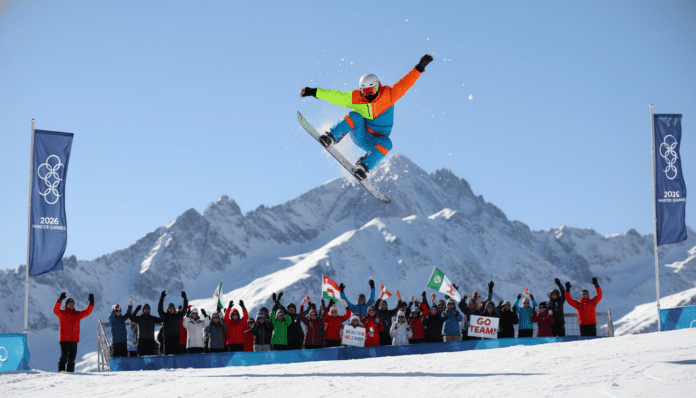
Can one venue change how a sport is watched around the world? Livigno Snow Park in Valtellina, Italy, arrives as a high-stakes stop on the Milano Cortina tour and it will shape headlines from February 5–18 (UTC+1).
Fans will see 11 medal events spread across park-and-pipe and head-to-head formats. Freestyle nights bring judged runs and viral moments, while racing offers raw, timed drama. That contrast makes each session feel distinct.
How athletes reach this stage matters. Qualification rules, quota slots, and start lists decide which names appear in medal runs and which storylines build into final days.
This guide previews the full event program, a schedule primer, qualification basics, Team USA outlook, and how recent world results feed momentum into Milano Cortina. It is factual now and forward-looking as competition unfolds.
Key Takeaways
- Livigno hosts 11 medal events from Feb 5–18 (UTC+1).
- Freestyle versus racing provide very different viewing experiences.
- Athlete quotas and qualification shape who competes on big nights.
- Use the schedule to choose live finals or highlight reels.
- Guide includes program, schedule preview, rules, Team USA outlook, and results context.
Snowboarding at the 2026 Winter Olympics in Milano Cortina: Key Dates, Venue, and the Big Storylines
Livigno’s slopes will shape which runs become headline moments in Milano Cortina. The snowboard program takes place at Livigno Snow Park in Valtellina, Italy, and blends park features with fast racing lines to suit both freestyle and cross formats.
Competition runs from February 5–18, all listed in (UTC+1). U.S. viewers should convert start times to local zones to catch live finals and prime-time sessions.
Eleven medal events span men’s and women’s fields plus a mixed team snowboard cross relay that adds national strategy and depth.
- Venue matters: Livigno’s design supports big air, pipe features, and race lanes, affecting course flow and spectator sightlines.
- Key narratives: Favorites arrive with World Cup momentum, but single-run pressure can reshuffle podium expectations.
- Event parity: Men’s and women’s formats offer equal medals; formats, judging cues, and course flow can differ.
“Schedule placement can turn a final into a must-watch prime-time moment.”
Next: a full program breakdown, a date-by-date finals preview, and how athletes earn start-list spots for cortina 2026 and milano cortina 2026.
Events to Watch: The Full Milano Cortina 2026 Olympic Snowboard Program
This program lays out 11 core events that split into two camps: scored freestyle runs and head-to-head racing. That split helps viewers pick what to watch live and what to study later.
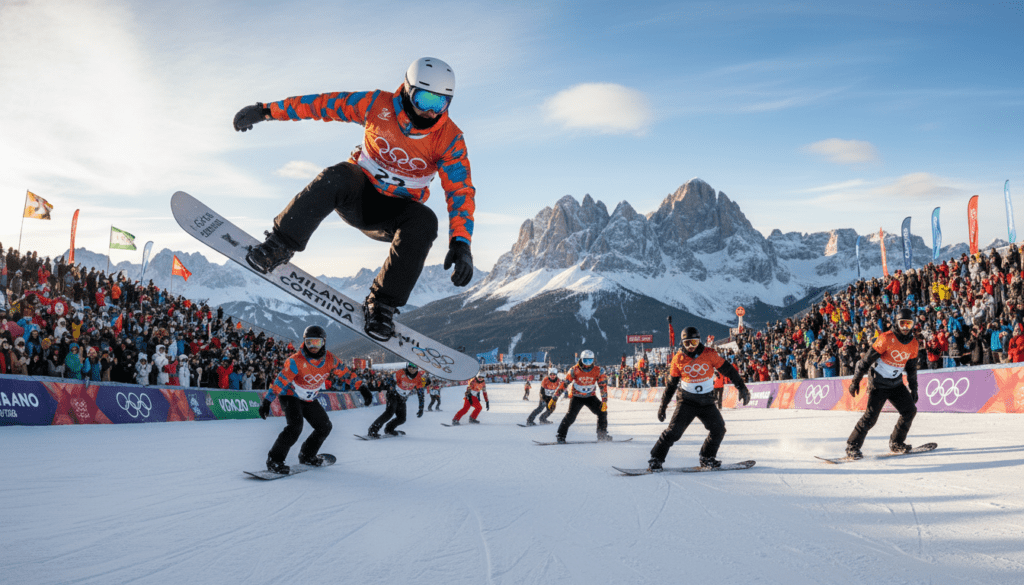
Big air (men and women)
Big air rewards amplitude, trick difficulty, and clean landings. A single botched landing can flip gold, silver, and bronze in one run.
Slopestyle (men and women)
Slopestyle combines rails and jumps into one run score. Consistency across features usually separates medal winners from near misses.
Halfpipe (men and women)
Halfpipe builds with back-to-back hits. Height, clean grabs, and flow create the iconic moments that mark event history.
Parallel giant slalom (men and women)
Parallel giant pairs riders on mirrored courses. It uses knockout rounds where starts and precision matter as much as raw speed.
Snowboard cross (men and women)
Snowboard cross is pack racing. Line choices, contact risk, and chaos make it the most unpredictable medal event, even for fast favorites.
Mixed team snowboard cross
The relay-style mixed team ties two runs into one medal chance. Team order and matchup strategy often decide outcomes as much as individual pace.
“Judged events ask for nuance; racing rewards timing and tactics.”
Viewer’s guide: First-time fans find cross and parallel giant easy to follow live. Freestyle shines with replays and judging breakdowns when viewers want to understand why athletes earn olympic medals.
Competition Schedule Preview: When Finals Hit in Livigno
A packed timetable in Livigno puts several finals into prime viewing windows. For fans tracking milano cortina action, this preview turns the official UTC+1 times into a simple guide to when medals are likely decided.
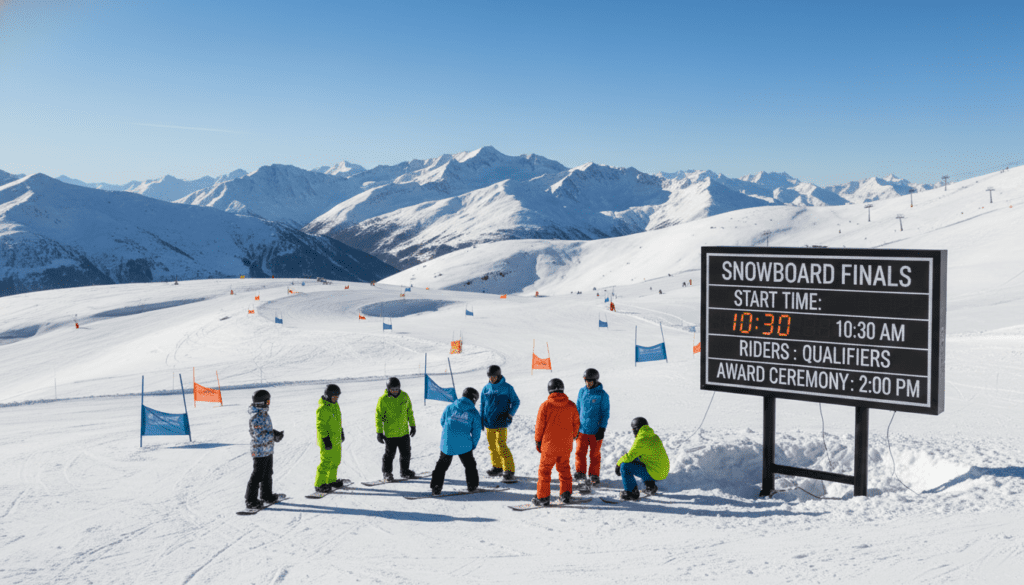
Opening nights under lights bring men’s big air on Feb 5 and again on Feb 7 at 19:30. Those evening sessions are set up as early showcases where athletes chase gold and build momentum for later events.
Parallel giant day
Feb 8 at 09:30 is a compact parallel giant block for women and men. The bracket format creates rapid-fire drama; a single error can end a gold run instantly.
Halfpipe block
Combined sessions land on Feb 11 at 10:30. Then women hit finals Feb 12 at 19:30 and men follow Feb 13 at 19:30. Back-to-back days can increase pressure and test athletes’ recovery.
Snowboard cross stretch
Men race on Feb 12 at 10:00, women on Feb 13 at 10:00, and the mixed team relay runs Feb 15 at 13:45. Clean starts and tactical riding often matter as much as raw speed for medal chances.
Slopestyle run-in
Qualification rounds begin Feb 16 at 10:30, with the women’s final Feb 17 at 13:00 and the men’s final Feb 18 at 12:30. Late-week scheduling can sharpen narratives as fatigue and form collide.
Viewing tip for U.S. audiences: All times are local (UTC+1). Convert schedule times early and plan around prime windows if watching live. For ski snowboard fans, focusing on evening finals usually captures the most decisive medal moments.
“Prime-time sessions often shape which runs become defining moments.”
How Qualification Works: Quotas, FIS Points, and What It Takes to Make the Start List
Making the start list requires clear performance benchmarks and strategic national choices. Each athlete must meet minimum FIS points and record a top-30 finish in a World Cup during 1 July 2024–18 January 2026 or at the 2025 World Championships.
Quota picture: There are 238 total athletes, split evenly with 119 men and 119 women. Country limits top out at 26 athletes per NOC, with a maximum of 13 per gender. That makes national selection highly competitive.
Event quotas and standards: Big air and slopestyle share a 30-per-gender quota. Halfpipe allows 25 per gender (min 50.00 FIS points). Parallel giant and snowboard cross each have 32 per gender (min 100.00 FIS points).
Spots follow the Olympic Quota Allocation List, with a max of four quota spots per NOC per event. When a nation declines or exceeds limits, vacated places are reallocated to the next eligible NOC. Late changes can shift start lists and affect medal outlooks.
Mixed team SBX: Teams need at least one qualified rider of each gender. Up to 16 teams can enter, with a maximum of three per NOC. This rule balances broad participation and a compact bracket for cortina 2026, keeping ski snowboard fans alert to late additions and results that alter medal chances.
Team USA Outlook: Qualified American Snowboarders and What They Bring to Cortina 2026
Team USA arrives with a balanced roster that blends veteran poise and youthful upside. This mix gives the squad options in both judged freestyle runs and head-to-head racing.
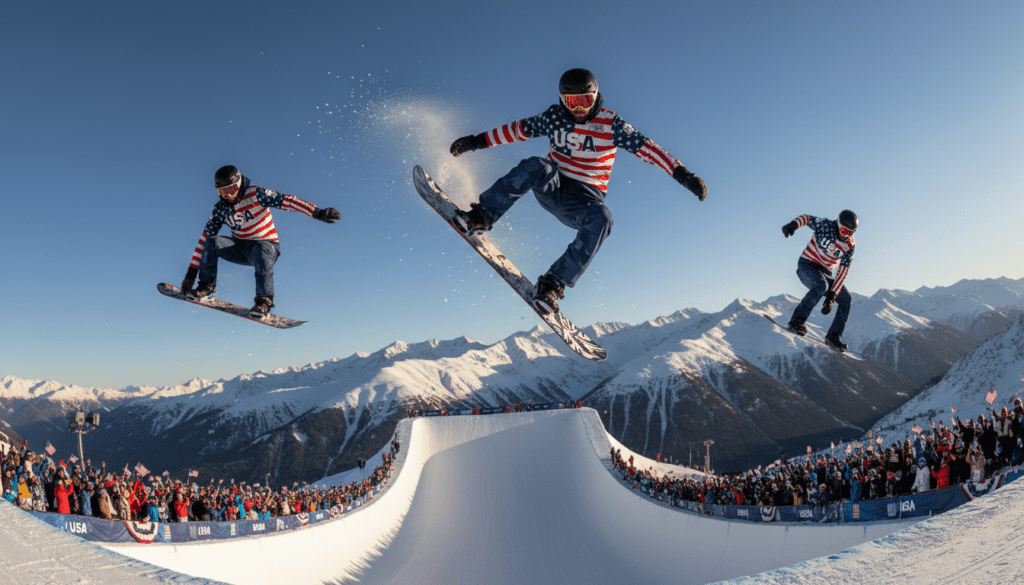
Headliners and returning Olympians
Red Gerard, Sean FitzSimons, Stacy Gaskill, and Chase Josey anchor the team. Their prior Games experience can translate to cleaner execution when pressure rises.
Veteran factor
Nick Baumgartner brings four prior appearances and steady race craft. That multi-Games perspective helps teammates manage qualification runs and tactical heats.
New names to know
Young prospects include Brianna Schnorrbusch, Alessandro Barbieri, Chase Blackwell, Jake Canter, and Lily Dhawornvej. First big-cycle moments can accelerate growth and spotlight future leaders.
“Depth across age groups expands medal upside, especially when veterans guide race-day decision making.”
| Athlete | Age / Hometown | Experience | Pathway |
|---|---|---|---|
| Red Gerard | 25, Silverthorne, CO | 2018, 2022, 2026 | Pro circuit |
| Sean FitzSimons | 25, Hood River, OR | 2022, 2026 | University of Utah |
| Nick Baumgartner | 44, Iron River, MI | 2010–2022 | West Iron County HS |
| Jake Canter | 22, Silverthorne, CO | First Games | Regional pro |
Why hometowns and pathways matter: access to mountains and training hubs affects repetition on features. College programs and local schools show how varied development can still produce elite athletes.
Medal outlook: gold-level runs usually need high difficulty plus repeatable landings or smart race craft. Team USA’s blend of veterans and newcomers creates multiple routes to an olympic medals push in Cortina, and gives ski snowboard fans reasons to watch both finals and qualifiers.
Medals and Momentum: What Recent Results Suggest About the 2026 Podium
Momentum from late-season results can rewrite podium predictions in nearly every discipline. Judged events reward progression and execution, while timed and head-to-head formats favor repeatable starts and clean runs.
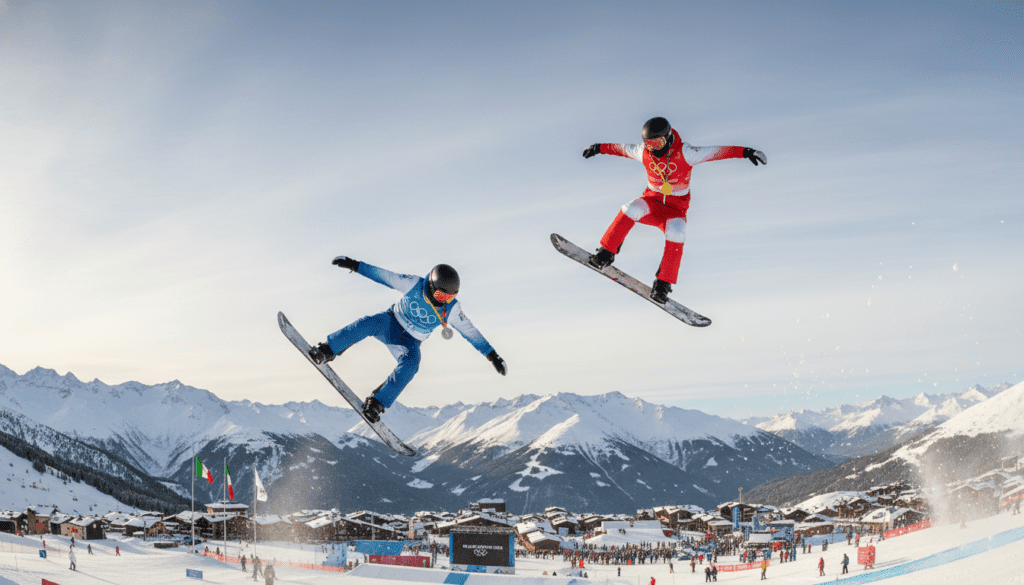
How judging and timing shape outcomes
Freestyle events—big air, slopestyle, halfpipe—pivot on trick difficulty and landing quality. A single high-scoring trick can vault an athlete from outside medal contention into gold range.
Racing formats, such as parallel giant and snowboard cross, rely on clean gates, line choice, and avoidance of contact. Time gaps and bracket wins give fewer chances for subjective swings.
Signals to track for medal forecasting
Look for three clear indicators that predict podium potential:
- Consistency across world events—multiple top finishes within a season.
- Frequency of top World Cup results versus one-off wins.
- Timing of qualification—early qualifiers often show steadier form; late qualifiers can be peaking.
Season timing matters. Athletes who peak near milano cortina and can perform in limited-run formats usually convert results into olympic medals.
“Iconic podium moments pair high difficulty with clean landings, or racers who avoid the single mistake that ends a bracket.”
| Format | Key Medal Driver | What to Watch |
|---|---|---|
| Freestyle (big air/slopestyle/halfpipe) | Execution + difficulty | Progression, landing percentage, judge scores |
| Parallel giant | Start consistency + precision | Head-to-head seeds, gate time, bracket recovery |
| Snowboard cross | Line choice + risk management | Clean heats, pack positioning, crash avoidance |
Men’s fields can be deeper in some events, which raises volatility rather than creating predictable gold, silver, bronze outcomes. For U.S. viewers, tracking clean-run consistency and world result trendlines shows whether American athletes favor judged runs or racing formats as cortina 2026 approaches.
Conclusion
Livigno’s mix of park lines and race lanes ties every run to a clear story: who lands big tricks and who races clean to a win.
Recap: milano cortina hosts 11 medal events at Livigno Snow Park from Feb 5–18. Use schedule blocks to prioritize prime finals and track which athletes trend upward as form settles. strong,
Qualification stays crucial: quotas cap fields, FIS points and a top-30 World Cup or World Championships result are required, and reallocations can still change start lists.
Each discipline produces medals differently—judged runs can spark surprise podiums while racing often punishes one mistake. Team USA’s blend of veterans and new talent boosts both medal hopes and narrative depth in milano cortina 2026.
As season results arrive, gold and bronze contenders sharpen, but history shows a single perfect run can rewrite forecasts.
FAQ
What events make up the Milano Cortina 2026 snowboard program?
The program includes big air, slopestyle, halfpipe, parallel giant slalom, snowboard cross for men and women, plus a mixed team snowboard cross relay. Eleven medal events in total will run in Livigno Snow Park and nearby venues.
Where and when will competitions take place?
Competition centers on Livigno Snow Park in Valtellina, Italy, with key dates between February 5 and February 18 (UTC+1). Night sessions, qualifying rounds, and finals are spread across that window.
How many athletes will compete and how are quotas distributed?
The quota allows 238 total athletes, split evenly between men and women. National Olympic Committees can enter up to 26 athletes (maximum 13 per gender). Event-specific limits vary by discipline.
What are the event-by-event quota numbers?
Big air and slopestyle share quotas of 30 athletes each, halfpipe seats 25, and parallel giant slalom and snowboard cross each have 32 starters. Mixed team snowboard cross is limited to 16 teams.
How do athletes qualify for the start list?
Athletes need minimum FIS points and a top-30 World Cup or World Championship result during the qualification window. NOCs earn quota slots based on ranking lists, then allocate spots internally following national criteria.
What happens to unused quota slots after the qualification window?
Unused slots are reallocated by the international federation using the Olympic quota ranking. Reallocation goes to the next eligible NOC until all places are filled or the reallocation deadline passes.
How does mixed team snowboard cross entry work?
Mixed team requires one male and one female from the same NOC. Sixteen teams max qualify; nations need individual quota spots in snowboard cross to field a pair. Reallocation can create additional eligible teams.
Which sessions should fans mark for finals and big moments?
Early highlights include men’s big air on February 5 and 7. Parallel giant slalom finals come February 8. Halfpipe finals cluster around February 11–13. Snowboard cross finals occur February 12–15, and slopestyle concludes February 16–18.
Who are the U.S. athletes to watch for Cortina?
Team USA features a mix of veterans and rising talent. Established names bring World Cup experience while younger competitors add momentum from recent international results. Selection depends on national trials and quota allocation.
How do judging and timing affect medal outcomes across disciplines?
Freestyle judged events rely on amplitude, difficulty, and execution, so consistency and high-scoring runs matter. Racing formats like parallel giant slalom and snowboard cross depend on reaction time, line choice, and clean heats; small margins decide medals.
What trends should analysts track when forecasting podiums?
Analysts watch World Cup standings, results from the 2025 World Championships, injury reports, and qualification consistency. Nations with deep development pipelines often convert depth into multiple medal threats.
Are there any venue or weather risks that could change the schedule?
Mountain weather can prompt schedule adjustments. Organizers plan backup windows and course maintenance; officials prioritize athlete safety and fair conditions when rescheduling sessions.
Where can viewers find live results and official start lists?
Official start lists and live results appear on the Olympic Games website and the international federation’s competition pages. Broadcasters and accredited timing partners also provide real-time updates during events.